


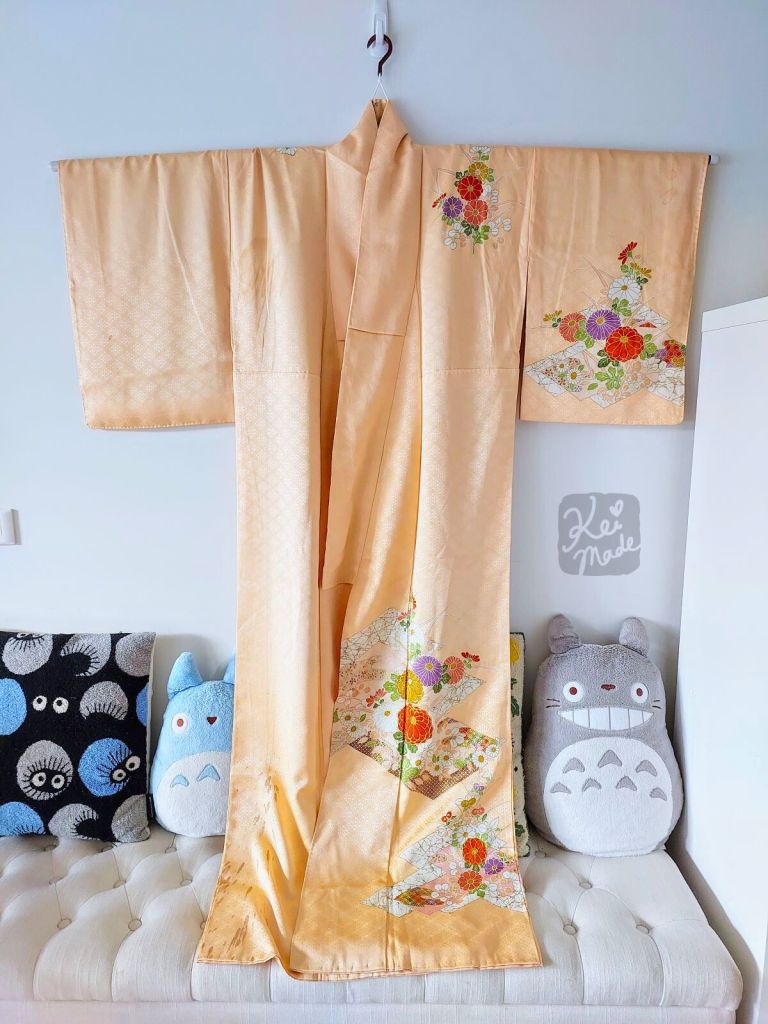
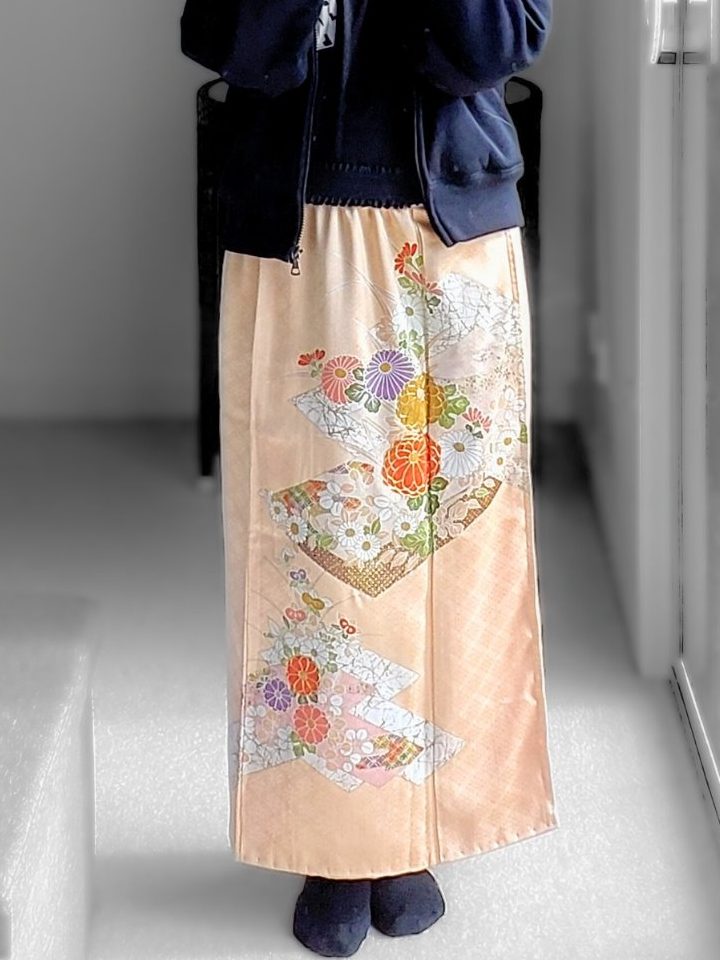
My mother lent this silk kimono to a friend, and it came back with coffee stains 30 years ago. So I decided to to prototype a faux wrap skirt that looks like a kimono bottom, but made with a big tack pleat for ease of walking.
Background
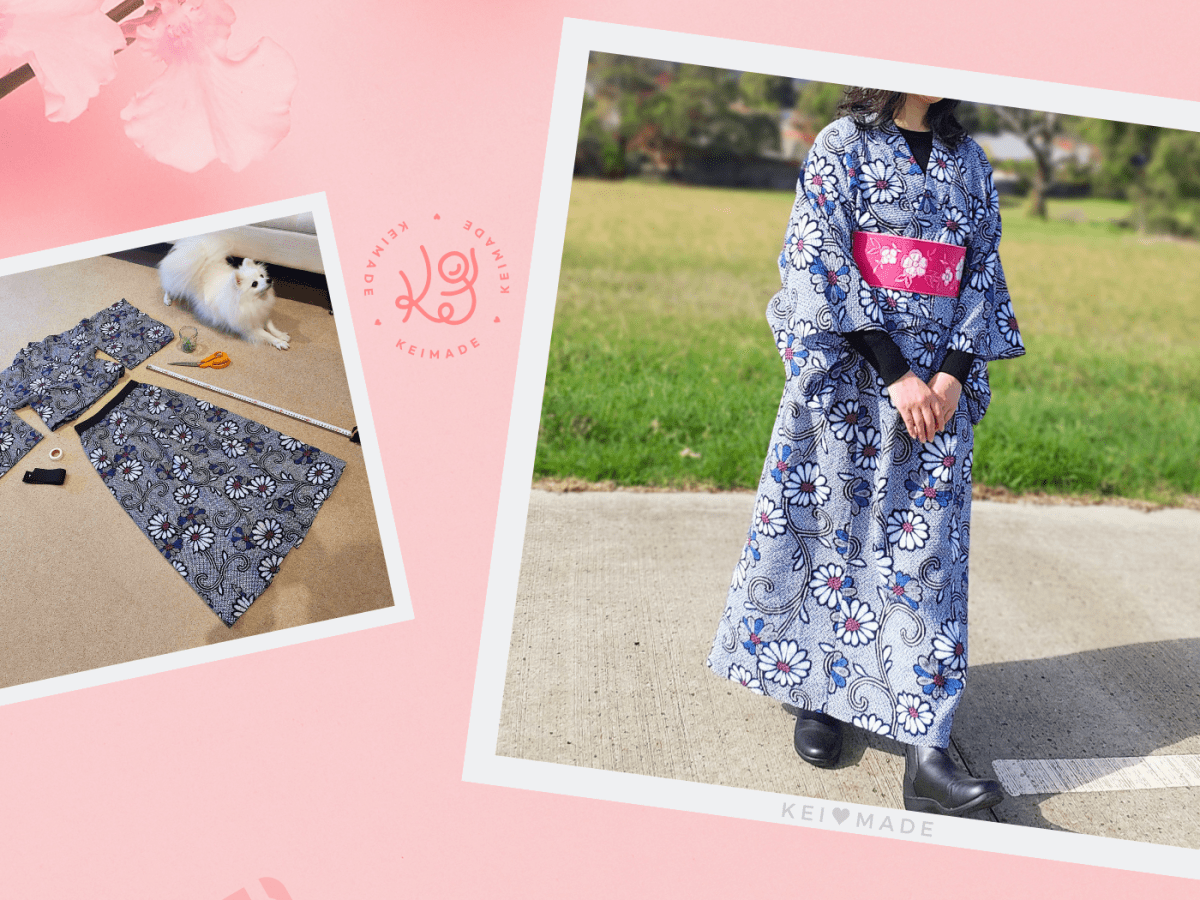
In my previous post, I made an elasticated wrap skirt from of a kimono to make a convincing two part kimono:
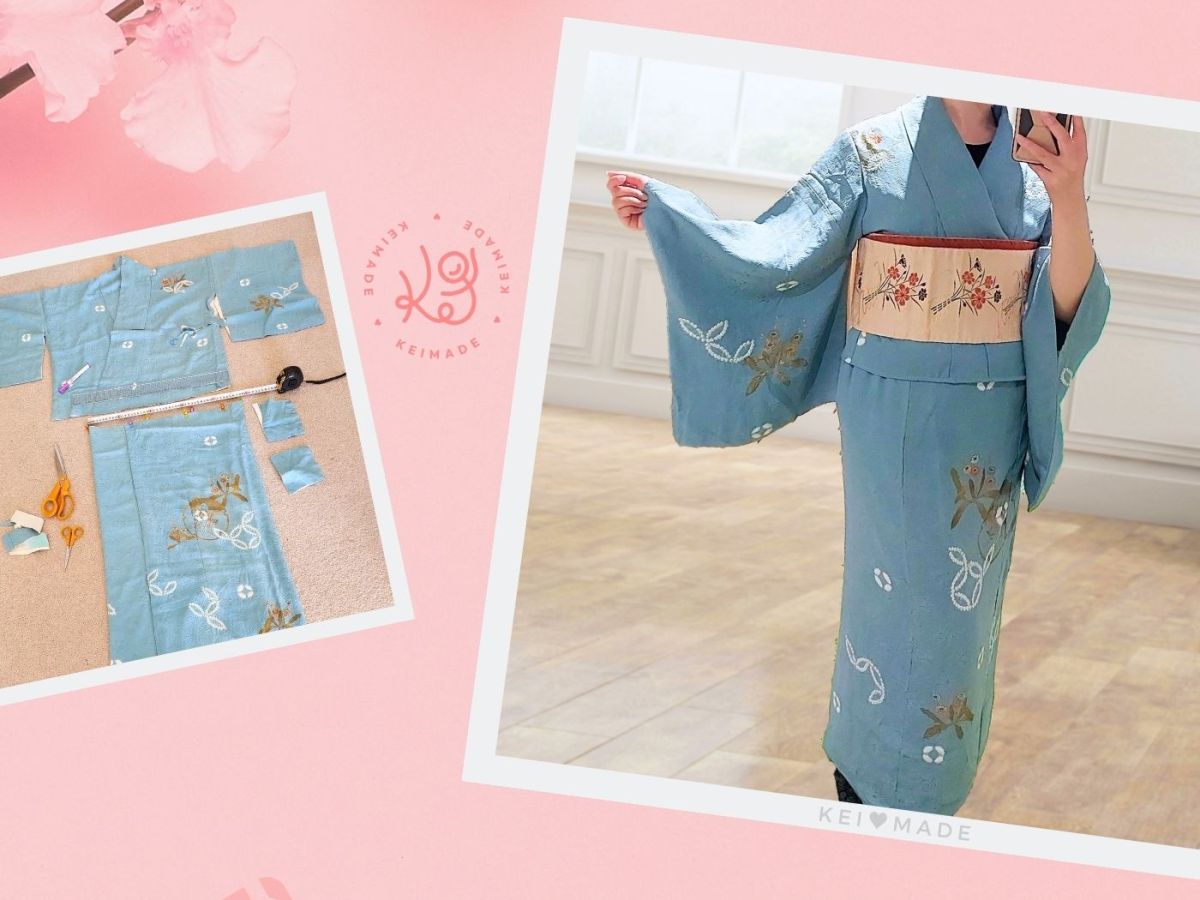
It looked the part, but it was a bit annoying to walk in as I would have to fight friction for the skirt to open up at every step, just like a conventional kimono.
So this time, I tired making a faux wrap skirt by making a big tack (single pleat) on one side, inspired by this Tacked Tight Skirt from Nomura Tailor:
Steps
Cut the bottom of the kimono.
This time I cut it at 80cm as I’ll be adding a 6cm-wide exposed elastic waistband.
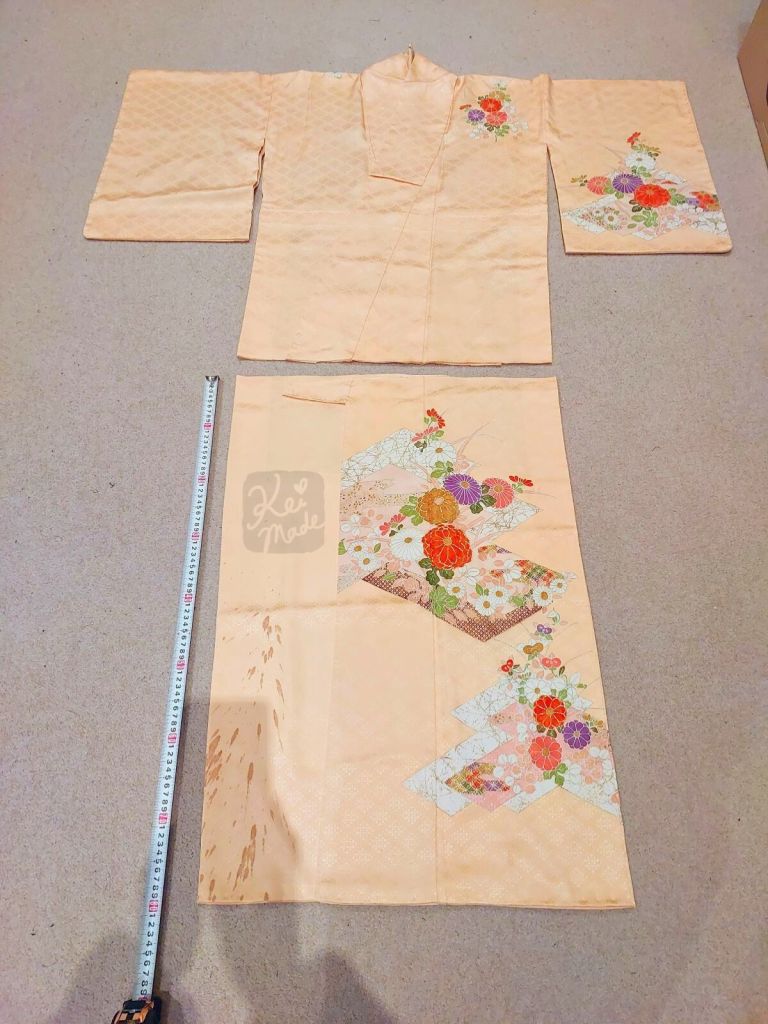
Take off the collar that extends to the skirt, and serge the raw edge.
Sew the vertical ends together, right way out, with the front fabric 5mm outwards. Leave 30cm as a slit.*
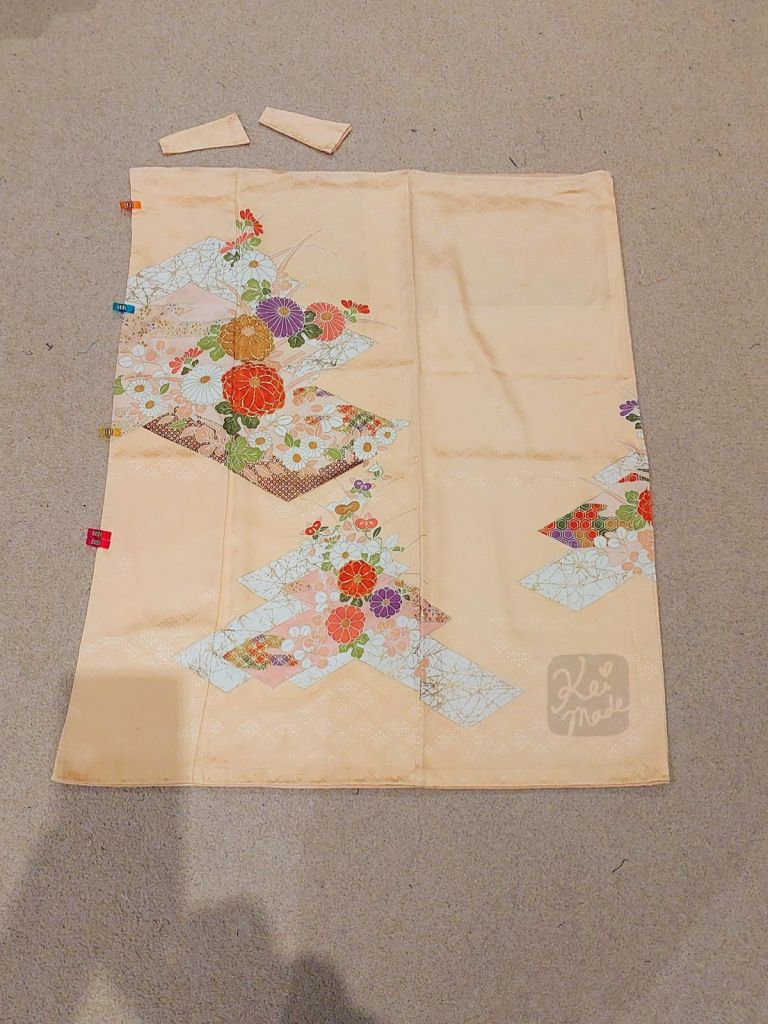
*The 30cm slit at the hem of the skirt was sewn closed later, as it would stay open and it wasn’t needed to walk freely in.
Fold a tack (single pleat) from the sewn edge inwards, so the width of the skirt becomes 50cm.

Make a basting stitch along the tack.
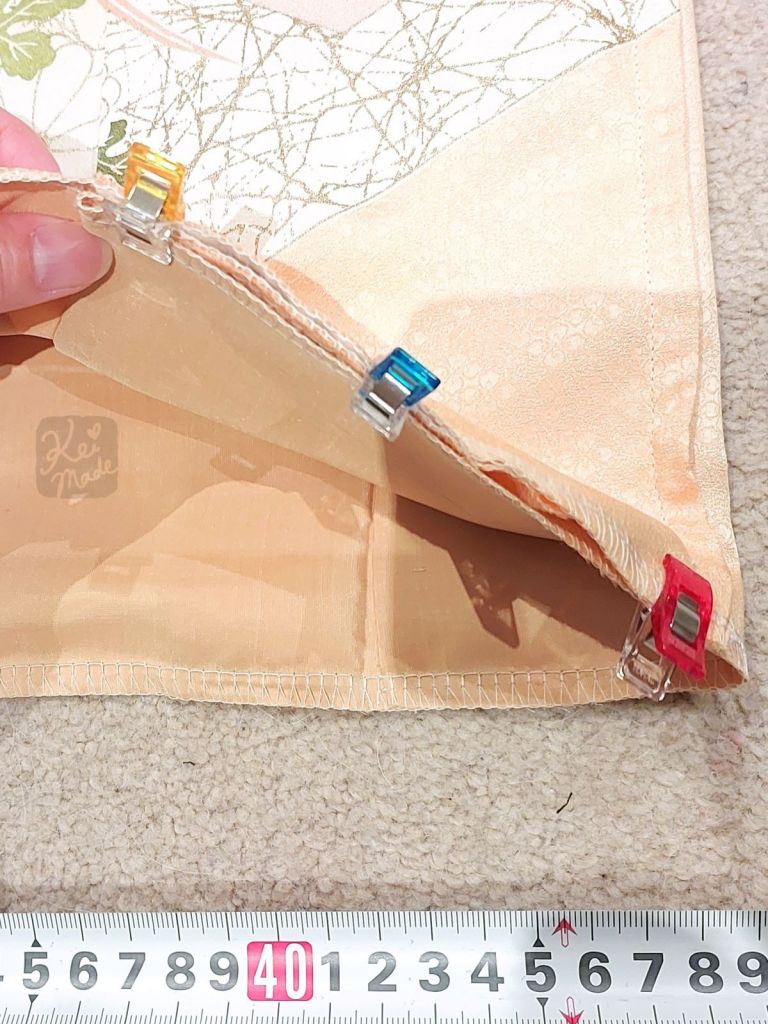
Sew on an elastic waistband.
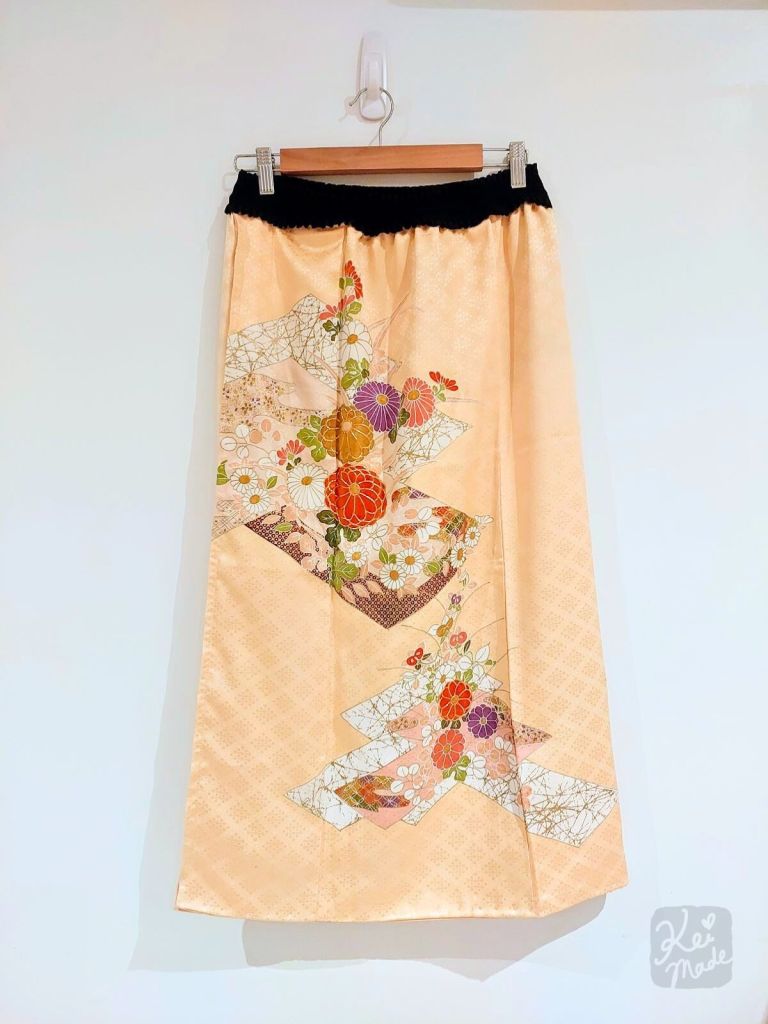
Outcome
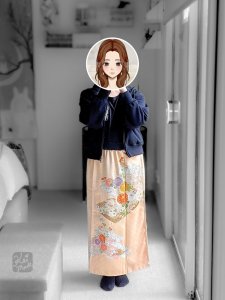
When paired with a kimono top, it looks less convincing as a real kimono to the trained eye, as the hem tapers outwards instead inwards.
But it is easier to talk in than the wrap skirt version, as there is less friction to fight when walking. There is close to no friction if the skirt is worn with the pleat edge worn right at the side.
Having said that, since the skirt tapers out anyway, it might as well be sewn without the tack pleat for full freedom when walking.
Like this one:
If an elastic casing is sewn on instead of an exposed elastic, then the fabric can be pinched and moved so all the gather moves to the back – making the front look more like a straight skirt.

Re-Upcycling
Now that I had prototyped and tested the tacked wrap skirt, I decided to pull it apart, remove the coffee stained panels, and upcycle it into a wearable skirt.
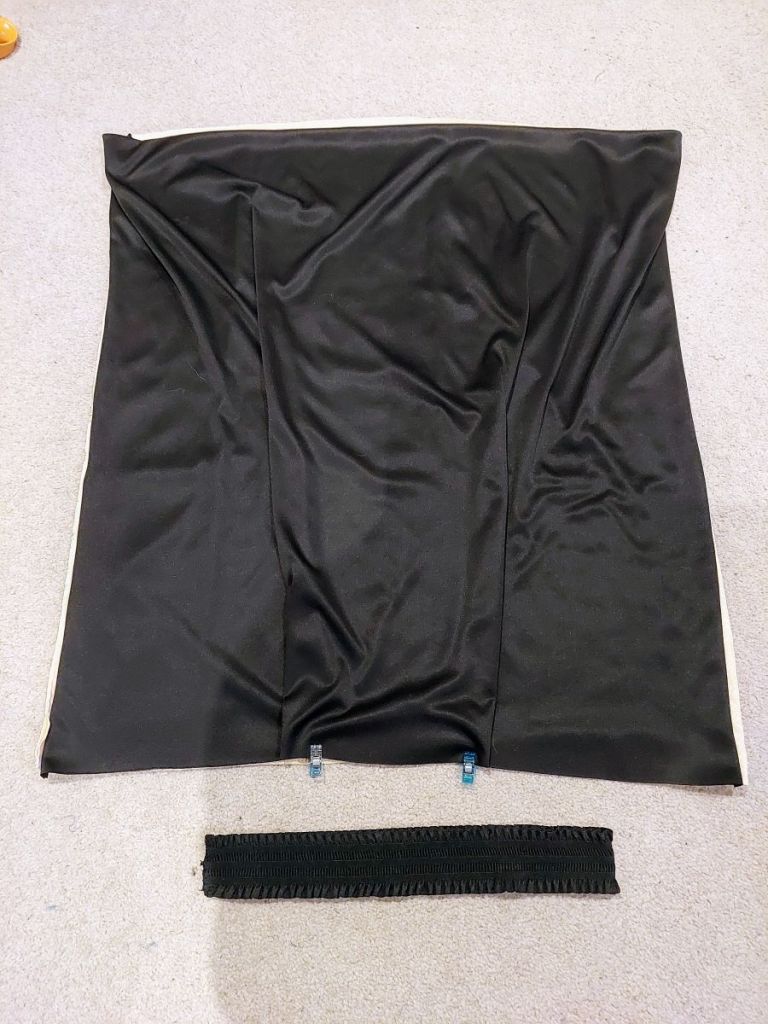
Once the coffee stained panels were cut off, the width was about 70cm. Because 140cm is not wide enough to take big strides in a long skirt, 90cm of the black fabric was cut to make the back skirt.
(The black knit fabric was a bit transparent so it was folded over at the bottom edge to double the fabric.)

Two tacks (soft pleats) were folded on the black panel – so that the colour change happens evenly at the sides, and also because the waistband elastic only stretches twice its width.
The top of the skirt was now 140cm in circumference, and the hem was 160cm. The sides were sewn together, and waistband elastic sewn on.
And here’s a dual toned panel skirt, using the kimono fabric at the front, and a black panel at the back.
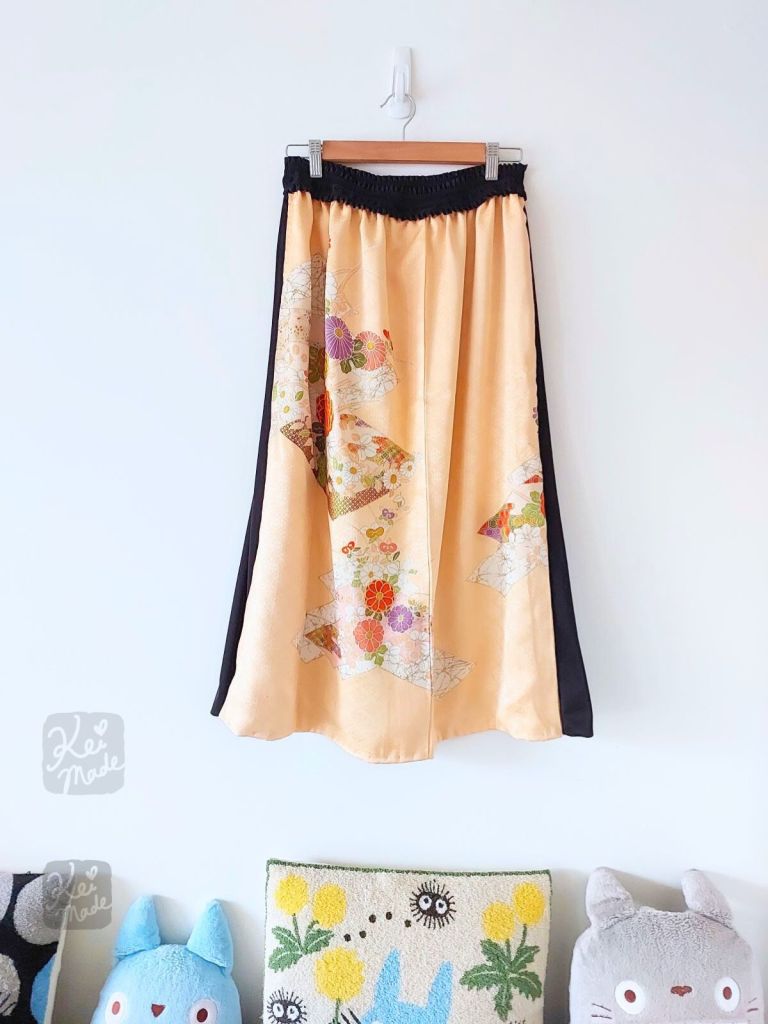

I’m planning to gift it back to my mum, so she can enjoy her kimono without the 30 year old coffee stains 🙂




Leave a Reply